Every life settlement transaction depends heavily on life expectancy analysis, which is why understanding life expectancy underwriting matters to anyone evaluating this asset class or considering the sale of a policy. Life expectancy underwriting is the process of estimating how long an insured is likely to live based on medical records, health history, and actuarial data. That estimate is one of the most important factors in determining what a policy is worth on the secondary market, and it shapes many of the decisions a buyer makes about a transaction, from the initial offer to how the policy is managed once purchased.
What Does Life Expectancy Underwriting Measure?
Life expectancy underwriting produces a projected number of months the insured is expected to live, along with a mortality curve that reflects the probability of death at various points along that timeline. This is different from the underwriting a life insurance carrier performs when a policy is first issued. At issuance, the carrier is assessing insurability and setting a premium based on broad actuarial classes. In a life settlement, the underwriter is assessing an already-issued policy and estimating a specific timeline for a specific individual, since that timeline is an important factor in determining the price a buyer is willing to pay today for a benefit that will be paid at an unknown future date.
The distinction matters because the two forms of underwriting are solving different problems. Issue underwriting asks whether an applicant is insurable and at what premium. Life expectancy underwriting asks a much narrower question about someone who is already insured: given everything currently known about this person’s health, what is the most probable timeline to a claim? That narrower, more individualized question is what makes the process so central to how a policy is priced on the secondary market.
What Medical Records Are Used in Life Expectancy Underwriting?
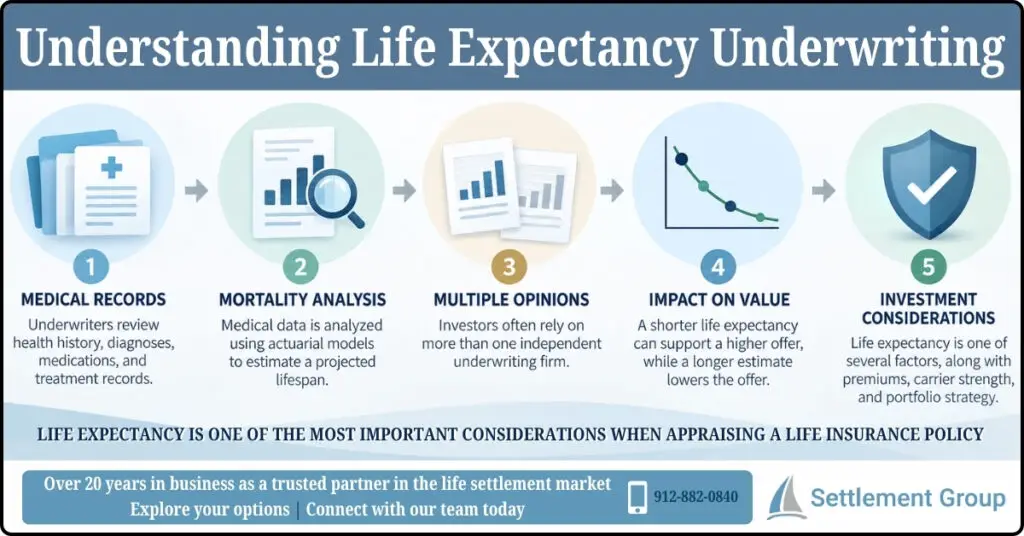
A life expectancy estimate is built from a detailed review of the insured’s medical records, typically covering several years of history. Underwriters look at diagnosed conditions, treatment history, medications, lab results, and physician notes, then apply mortality tables adjusted for the insured’s specific health profile. Age and gender form the baseline, but the estimate is refined significantly by conditions such as cardiovascular disease, diabetes, or cancer history, each of which can affect projected longevity.
Underwriters also weigh factors that are easy to overlook, such as how well a chronic condition is being managed, whether a diagnosis is stable or progressing, and how recent lab work compares to prior results. Two insureds with the same diagnosis can receive meaningfully different life expectancy estimates depending on how the condition is being controlled and what the trend in the medical record shows over time. This is part of why a life expectancy report reads more like a clinical case review than a simple actuarial table lookup.
Why Do Life Settlement Buyers Use More Than One Underwriting Firm?
Because the life expectancy estimate has such a direct effect on valuation, life settlement transactions may involve underwriting from more than one independent firm. Two firms reviewing the same medical file can produce different estimates since each uses its own proprietary mortality models, data, and clinical judgment. Investors may incorporate multiple estimates into their valuation methodology to reduce the risk of relying too heavily on a single firm’s assumptions.
This layered approach can also help account for differences in how underwriting firms evaluate particular conditions or age ranges. Mortality models are built and refined using historical data, and firms can differ in how they account for newer treatments, changes in survival rates for certain conditions, or emerging medical research. Using more than one underwriting opinion gives an investor an additional way to evaluate assumptions rather than relying entirely on a single methodology.
How Does Life Expectancy Affect a Policy’s Value?
Life expectancy influences value because it helps determine how long a buyer expects to pay premiums before receiving the death benefit. A longer life expectancy generally means premiums must be paid for a longer period, increasing the buyer’s expected cost to maintain the policy and potentially reducing the amount the buyer is willing to pay upfront. A shorter life expectancy generally has the opposite effect. Fewer expected years of premium payments between the purchase and the eventual death benefit can support a higher offer as a percentage of face value.
Life expectancy, however, is only one component of the valuation. Investors also evaluate the policy’s face value, premium requirements, policy structure, cost of insurance, and the financial strength of the issuing carrier. These factors work together to determine the value as a life settlement, which is why two policies with identical face values can receive very different offers.
The premium schedule itself interacts with the life expectancy estimate in ways that can significantly affect value. A policy with lower ongoing premiums relative to its face value may support a stronger offer even with a moderate life expectancy estimate because the buyer’s expected carrying cost during the holding period is lower. This is one reason a current in-force illustration from the carrier, alongside medical underwriting, is a standard component of life settlement evaluation.
How Accurate Is a Life Expectancy Estimate?
Life expectancy underwriting is a statistical estimate, not a guarantee. An insured can outlive the projection, sometimes significantly. This creates longevity risk because the investor must continue funding premiums for longer than anticipated while the receipt of the death benefit is delayed.
Longevity risk is one of several risks investors evaluate when purchasing life settlements. Premium risk, carrier risk, policy structure, and portfolio concentration can also affect investment performance. Institutional investors may mitigate some individual longevity risk by holding pools of policies across multiple insureds rather than relying on the outcome of a single transaction. While individual life expectancy estimates can vary substantially from actual outcomes, diversification can reduce the impact that any one insured’s longevity has on the overall portfolio.
How Does Life Expectancy Underwriting Affect Life Settlement Investing?
For investors, life expectancy underwriting is a critical input in evaluating expected holding periods, premium obligations, projected returns, and the overall risk profile of a life settlement. Small differences in projected longevity can materially affect expected cash flows, particularly when a policy carries substantial annual premiums.
Life expectancy analysis also helps investors evaluate policies within the context of a broader portfolio. Rather than viewing an LE estimate as a precise prediction of an individual outcome, investors can use mortality projections alongside policy economics and portfolio-level assumptions to assess risk and expected performance.
For a policyholder considering a sale, the same process helps explain why detailed medical records are required and why offers can vary among buyers. Different underwriting assumptions and valuation methodologies can produce different assessments of the same policy.
If you would like to learn more about how life expectancy underwriting affects an investment in life settlements, or how it factors into a potential sale of your own policy, please give us a call. 912-882-0840