Life insurance policies are traditionally purchased to provide financial protection for beneficiaries, but an existing policy can also have value as a transferable asset. The secondary market for life insurance allows eligible policyholders to sell their policies to third-party buyers rather than surrendering them to the issuing carrier or allowing coverage to lapse. For investors, this market provides access to an asset class whose performance is tied primarily to insured mortality, premium obligations, and policy-specific economics.
Understanding how the market developed, how transactions are structured, and how state regulation governs participants helps explain why a life insurance policy can have a market value beyond its cash surrender value.
What Is the Secondary Market for Life Insurance?
The secondary market for life insurance involves the purchase and sale of existing life insurance policies between policyholders and third-party buyers. These transactions are known as life settlements.
In a life settlement, the policyholder receives a cash payment in exchange for transferring ownership and beneficiary rights to the buyer. The buyer assumes responsibility for future premium payments and receives the death benefit when the insured passes away.
This differs from surrendering a policy to the issuing insurance company. A surrender terminates coverage in exchange for any available cash surrender value, while a life settlement transfers the existing policy to a new owner.
For policies with little or no cash surrender value, the secondary market may provide an opportunity to receive compensation for coverage that would otherwise be surrendered or allowed to lapse. However, not every policy qualifies for a settlement, and the amount offered depends on the policy’s characteristics and the insured’s health.
For investors, the secondary market creates an opportunity to acquire existing insurance contracts and evaluate them based on expected future cash flows, premium requirements, and the timing of the death benefit.
How Did the Secondary Market for Life Insurance Develop?
The legal foundation for the secondary market dates to the 1911 U.S. Supreme Court decision Grigsby v. Russell, which recognized the transferability of a valid life insurance policy to a purchaser without an insurable interest in the insured’s life.
The case involved John C. Burchard, who needed money for a surgical operation and sold his existing life insurance policy to Dr. Grigsby for $100. Grigsby also agreed to pay the outstanding and future premiums. After Burchard died, a dispute arose over whether Grigsby was entitled to the death benefit despite having no insurable interest in Burchard’s life.
Justice Oliver Wendell Holmes, writing for the Court, distinguished between purchasing a policy on another person’s life without an insurable interest and acquiring an existing policy that was validly issued. The Court upheld the assignment and recognized that restricting an owner’s ability to sell a valid policy would diminish its value as property.
The decision established an important legal distinction: a policy that was validly obtained can generally be transferred to another party, subject to applicable law. It did not eliminate insurable interest requirements at policy issuance or authorize policies created as wagering arrangements.
The modern settlement industry developed decades later, particularly during the 1980s and 1990s, when viatical settlements emerged as a means for terminally ill policyholders, including people affected by the AIDS epidemic, to access the value of their life insurance during their lifetimes.
As medical treatments improved and the market evolved, settlement transactions expanded beyond terminal illness. Life settlements increasingly became an option for older policyholders, often age 65 or above, whose financial circumstances or insurance needs had changed.
The development of a broader seller population also created opportunities for institutional investors to acquire policies individually or through investment funds and other portfolio structures.
How Does the Secondary Market for Life Insurance Work?
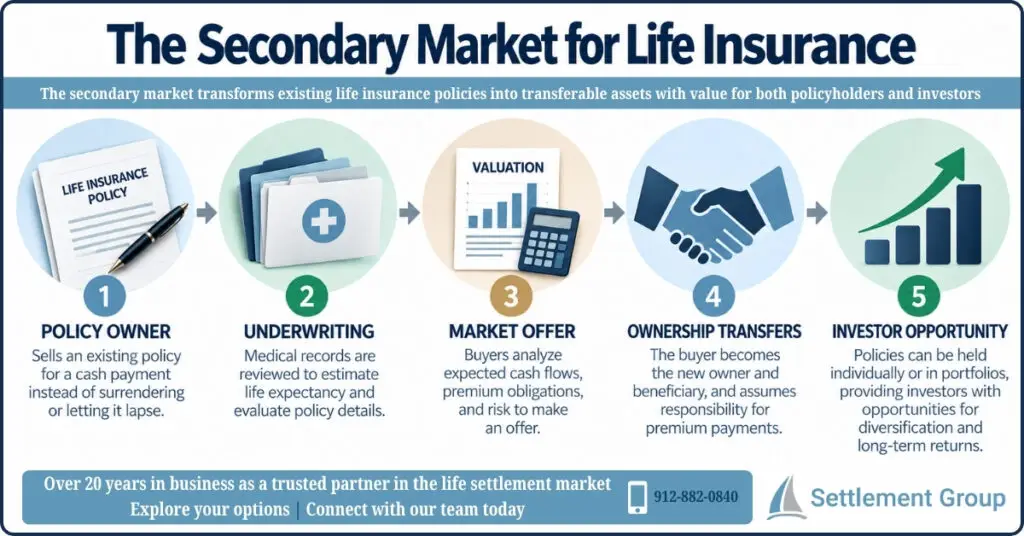
A life settlement begins when a policyholder decides to explore the potential value of an existing policy beyond the cash surrender value. The policy is evaluated to determine whether it meets a buyer’s acquisition criteria.
The evaluation generally includes a review of the policy’s face value, premium requirements, cash surrender value, ownership structure, and current in-force illustration. Medical records are also reviewed to estimate the insured’s life expectancy.
These factors help determine the policy’s expected holding period and the cost of maintaining coverage until the death benefit becomes payable.
A buyer then evaluates the anticipated cash flows and determines an offer based on its investment criteria and required return.
If the policyholder accepts an offer and the transaction is completed, ownership and beneficiary rights transfer to the purchaser. The purchaser assumes responsibility for maintaining the policy and ultimately receives the death benefit.
The process connects two distinct objectives: providing policyholders with an alternative to surrender or lapse and allowing investors to acquire policies.
Who Regulates Life Settlement Transactions?
Life settlements are primarily regulated at the state level. State insurance departments oversee applicable licensing requirements, transaction procedures, disclosures, and other regulatory obligations.
The National Association of Insurance Commissioners (NAIC) developed the Viatical Settlements Model Act to provide a framework for regulating settlement transactions. The model addresses areas including licensing, disclosure requirements, privacy, prohibited practices, and fraud prevention.
States may adopt, modify, or use portions of the model when establishing their own regulatory requirements. Consequently, licensing standards, permissible transactions, waiting periods, and consumer protections can differ by state.
This state-based framework is an important consideration for providers and institutional investors operating across multiple markets. A transaction that is permissible in one state may be subject to different requirements in another, making regulatory compliance an essential component of the acquisition process.
How Does State Regulation Protect Policyholders?
State life settlement laws establish requirements intended to protect policyholders and promote transparency throughout the transaction process.
Depending on the jurisdiction, these protections may include licensing requirements for providers and brokers, disclosures concerning settlement alternatives, restrictions on transactions involving recently issued policies, and the right to rescind a completed settlement within a specified period.
The NAIC model also addresses disclosure of potential tax consequences, creditor claims, and effects on eligibility for certain government benefits.
These protections are particularly important because selling a policy is a permanent financial decision once the applicable rescission period has expired. The seller relinquishes ownership and beneficiary rights, and the death benefit is no longer payable to the seller’s previously designated beneficiaries.
For investors, the regulatory framework also establishes requirements that must be addressed during acquisition, including verifying the legitimacy of the policy, confirming the seller’s authority to transfer ownership, and ensuring that the transaction complies with applicable law.
Who Participates in the Secondary Market for Life Insurance?
Several participants may be involved in a life settlement transaction, each performing a different function.
Life Settlement Providers
Providers are licensed entities that enter into settlement contracts with policyholders. A provider may purchase policies for its own account or facilitate transactions involving other buyers.
Life Settlement Brokers
Brokers represent policyholders in seeking settlement offers. Their responsibilities and licensing requirements are determined by applicable state law.
Life Expectancy Underwriting Firms
These companies review medical records and other relevant information to estimate an insured’s remaining life expectancy. These estimates are important inputs in determining the expected holding period and valuation of a policy.
Institutional Investors and Investment Funds
Investors provide capital to acquire policies, either directly or through arrangements involving licensed providers. Depending on the investment structure, policies may be held individually or combined into portfolios.
Policy Servicing Companies
Servicing companies may administer purchased policies, coordinate premium payments, monitor policy status, and assist with death benefit claims.
The roles can overlap depending on the transaction and investment structure. A licensed provider, for example, may purchase a policy directly or facilitate an acquisition for an institutional buyer.
Understanding these relationships is important for evaluating how policies move from individual ownership into investment portfolios.
How Are Life Insurance Policies Valued in the Secondary Market?
A policy’s value in the secondary market is determined by more than its face amount or cash surrender value.
Investors evaluate the relationship between the anticipated death benefit, the purchase price, the cost of maintaining coverage, and the expected timing of the eventual claim.
Life expectancy underwriting is a critical component of this analysis because it helps estimate how long premiums may need to be paid before the death benefit is received.
A shorter projected life expectancy generally reduces the anticipated holding period and premium obligations, potentially supporting a higher purchase price. A longer projected life expectancy generally increases expected carrying costs and delays receipt of the death benefit.
However, life expectancy alone does not determine value. Investors must also consider premium schedules, policy structure, cost of insurance, carrier financial strength, and the possibility that the insured lives substantially longer than projected.
Two policies with identical face values can therefore have very different market valuations.
The secondary market allows these characteristics to be evaluated collectively, creating a price based on the expected economics of the individual policy rather than solely on its surrender value.
Why Do Institutional Investors Participate in the Secondary Market?
Life settlements offer institutional investors exposure to an asset class whose underlying benefit payments are linked primarily to insured mortality rather than directly to stock market performance or corporate earnings.
This characteristic can make life settlements relevant to portfolio diversification strategies, although actual investment performance also depends on acquisition costs, premium obligations, financing, servicing expenses, and other factors.
Investors may acquire policies individually or through diversified portfolios containing multiple insureds, carriers, and policy structures.
Portfolio construction is particularly important because individual life expectancy estimates are statistical projections rather than guarantees. An insured who lives longer than expected creates additional premium obligations and delays the death benefit, potentially reducing the realized return.
By evaluating policies collectively, investors can assess aggregate mortality expectations, projected cash flows, and concentration risk rather than relying exclusively on the performance of a single policy.
The ability to acquire and manage portfolios has helped establish life settlements as a specialized investment asset class, supported by medical underwriting, actuarial analysis, policy servicing, and regulatory compliance.
What Should Investors and Policyholders Know About the Secondary Market?
The secondary market for life insurance serves different purposes for policyholders and investors, but both depend on the same underlying transaction: the transfer of an existing policy in exchange for compensation.
For policyholders, the market can provide an alternative to surrendering or lapsing coverage that is no longer needed or affordable. Evaluating an offer requires an understanding of the policy’s value, the loss of the death benefit for existing beneficiaries, potential tax consequences, and other available options.
For investors, the market provides access to existing insurance contracts that can be evaluated through medical underwriting, actuarial projections, and financial analysis. Investment performance depends on disciplined acquisition, accurate policy information, ongoing premium management, and the timing of death benefit payments.
A clear understanding of the regulatory framework, transaction participants, and valuation process is essential to evaluating opportunities on either side of the market.
Settlement Group works directly with policyholders and their financial representatives to purchase life insurance policies and facilitate settlement transactions involving other buyers. If you would like to learn more about the secondary market for life insurance, whether from an investment perspective or as a policyholder considering a sale, give us a call at 912-882-0840.