
For investors evaluating alternative assets, understanding how life settlement investing works starts with a simple premise. A life insurance policy is a contract with a market value that can exceed its cash surrender value. When a policyholder no longer needs or wants a policy, that policy can be sold on the secondary market rather than lapsed or surrendered. The buyer becomes the new owner and beneficiary, takes over premium payments, and receives the death benefit when the insured passes away. That transaction is the foundation of the life settlement asset class.
How Does a Policy Enter the Secondary Market?
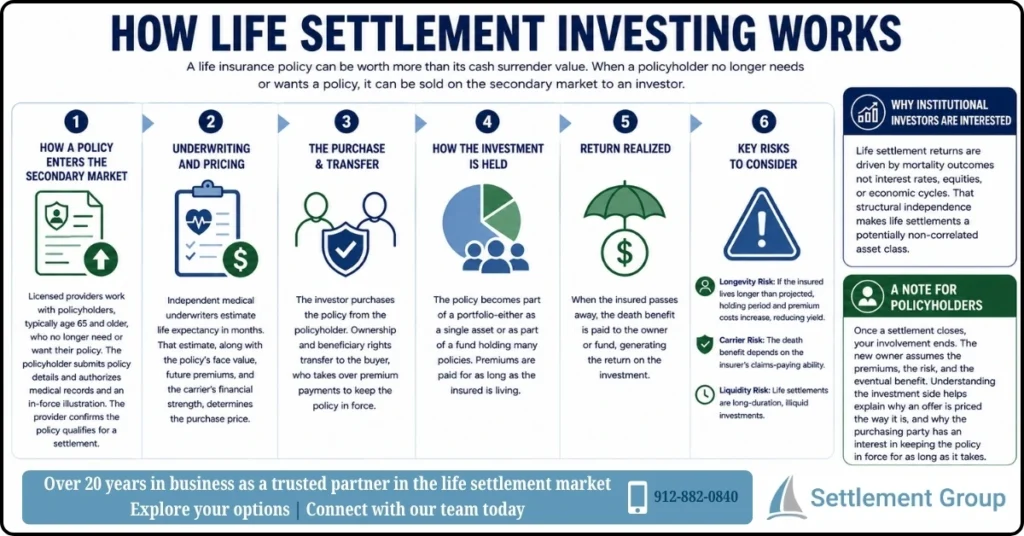
Life settlement transactions typically originate through licensed providers or brokers who work directly with policyholders, most often individuals age 65 and older whose health, financial needs, or coverage goals have changed since the policy was issued. The process begins with the policyholder submitting basic policy information along with authorization to obtain medical records and an in-force illustration from the carrier. A licensed provider reviews this information to confirm the policy qualifies for a settlement before the transaction moves into underwriting.
How Are Life Settlements Underwritten and Priced?
Life expectancy underwriting is the central diligence step in any life settlement transaction. Independent medical underwriting firms review the insured’s medical history and produce a life expectancy estimate, expressed as a projected number of months. That estimate, combined with the policy’s face value, the cost of future premiums, and the financial strength rating of the issuing carrier, determines the purchase price.
In general, a shorter life expectancy relative to the ongoing premium cost supports a higher purchase price as a percentage of face value. A longer life expectancy has the opposite effect, since the buyer will need to fund premiums over a longer period before the death benefit is paid.
How Is a Life Settlement Investment Held?
Once a policy is purchased, it becomes part of a portfolio, whether held as a single asset or pooled across many policies within a fund structure. The buyer, or the fund on behalf of its investors, takes over responsibility for paying premiums to keep the policy in force for as long as the insured is living. The return is realized when the insured passes away and the death benefit is paid.
What Are the Risks of Life Settlement Investing?
Longevity risk is the most significant factor in life settlement investing: if the insured lives longer than projected, the holding period extends and premium costs rise, reducing effective yield. Carrier risk matters too, since the death benefit is only as reliable as the issuing insurer’s claims-paying ability. Liquidity is a further consideration, since life settlements are a longer-duration, illiquid holding relative to public securities.
Why Do Institutional Investors Choose Life Settlements?
Life settlement returns are tied to mortality outcomes rather than interest rates, equities, or economic cycles. That structural independence is why life settlements are frequently discussed as a non-correlated asset.
What Should Policyholders Know About Life Settlement Investing?
Policyholders who arrive at this page while researching a potential sale of their own policy are approaching the same transaction from the other side of the table. Once a settlement closes, the policyholder’s involvement ends. The new owner assumes the premiums, the risk, and the eventual benefit. Understanding how the investment side of the transaction works can help clarify why an offer is priced the way it is, and why the purchasing party has an interest in keeping the policy in force for as long as it takes.
Contact Us
Whether you are exploring life settlements as an investment or considering the sale of your own policy, we’re available to answer questions and walk through next steps. Call 912-882-0840 to speak with our team.