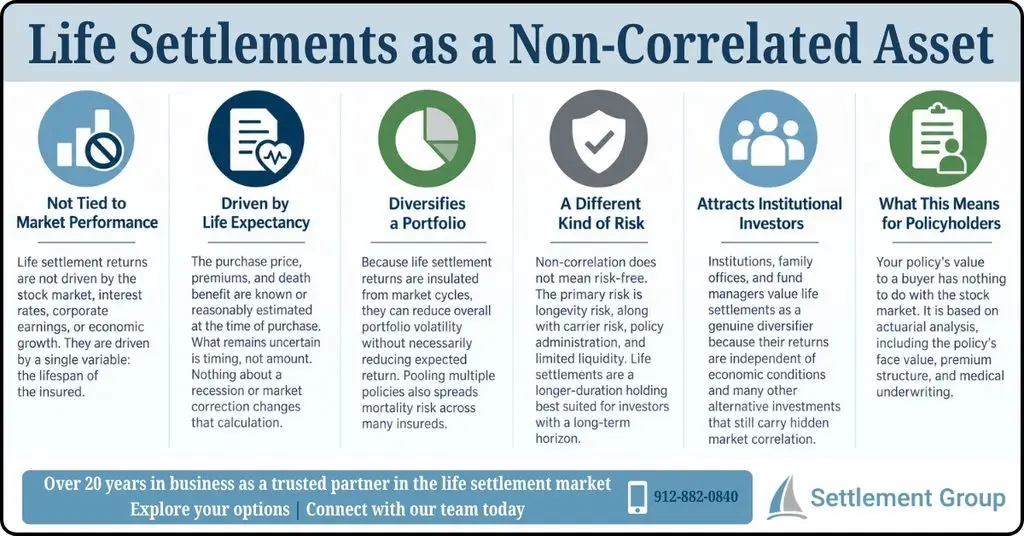
Investors building a diversified portfolio are often looking for holdings that behave independently of the broader market, which is why life settlements as a non-correlated asset draw attention from institutions, family offices, and fund managers. Unlike equities, bonds, or real estate, a life settlement’s return is not driven by interest rates, corporate earnings, or economic growth. It is driven by a single variable: the lifespan of the insured. That distinction sets the asset class apart from nearly everything else available to an institutional investor, and it is a major reason life settlements have grown in popularity as a portfolio diversification tool in recent years.
What Does Non-Correlated Mean in Investing?
A non-correlated asset is one whose performance does not move in tandem with stock or bond markets. When equities decline during a recession, a life settlement portfolio is unaffected, since the value of the underlying policies has nothing to do with corporate performance or interest rate policy. The death benefit owed under a life insurance contract is a fixed, contractual obligation of the issuing carrier, set at the time the policy was written, regardless of what happens in the broader economy.
This is different from many so-called alternative investments, which still carry hidden correlation to public markets through financing costs, valuation multiples, or investor sentiment. Private equity, for example, is ultimately valued against public market comparables and financed with debt that is sensitive to interest rate policy. Real estate is affected by financing costs, employment trends, and regional economic conditions. Even commodities can move with inflation expectations and currency policy. Life settlements sit outside that chain entirely. A policy purchased today has a death benefit that does not fluctuate with any of those forces.
What Drives Life Settlement Returns?
Every life settlement transaction is priced using life expectancy underwriting, which estimates how long the insured is likely to live based on medical history, current health status, and actuarial data. The purchase price, ongoing premium obligations, and eventual death benefit are all known or reasonably estimated at the time of purchase. What remains uncertain is timing, not amount. That single point of uncertainty, the actual date of death relative to the projected life expectancy, is the entire risk and return driver of the asset. Nothing about a recession, a rate hike, a market correction, or a change in monetary policy changes that calculation.
This makes the underwriting process the most important part of any life settlement transaction from an investment standpoint. The quality of the life expectancy estimate, and the medical underwriting firm that produced it, has a far greater effect on realized returns than any macroeconomic factor. Investors and funds active in this space typically require independent underwriting from more than one firm before finalizing a purchase, specifically because the accuracy of that estimate is where the real investment risk resides.
How Do Life Settlements Diversify a Portfolio?
Because life settlement returns are insulated from market cycles, adding them to a portfolio can reduce overall volatility without necessarily reducing expected return. This is the core appeal for institutional investors who are already exposed to equities, fixed income, and real estate and are looking for a genuine diversifier rather than another asset that quietly tracks the same macro conditions during a downturn.
Pooling multiple policies within a fund structure also diversifies mortality risk across a larger number of insureds, which reduces the impact of any single policy performing outside its projected life expectancy. A fund holding dozens or hundreds of policies benefits from the law of large numbers in much the same way an insurance company does when it writes policies across a broad population. Individual outliers, where an insured lives significantly longer or shorter than projected, tend to smooth out across the portfolio as a whole, which is one reason institutional investors often prefer pooled structures over single-policy purchases.
What Are the Risks of a Non-Correlated Asset Like Life Settlements?
Non-correlation does not mean risk-free. Longevity risk remains the primary consideration: if insureds in a portfolio live longer than projected, premium costs rise and the holding period extends, which affects realized yield relative to the original underwriting assumptions. Carrier risk and policy administration are also part of ongoing due diligence, since the death benefit is only as reliable as the issuing insurer and the accuracy of the underlying life expectancy estimates.
Liquidity is a related consideration. Life settlements are a longer-duration holding, and investors should not expect to exit a position the way they might sell a publicly traded security. This makes the asset class better suited to investors with a longer investment horizon and an ability to hold through the natural variability in mortality timing across a portfolio.
What Does This Mean for Policyholders?
If you hold a life insurance policy and are researching how it might be valued in a settlement transaction, the non-correlated nature of this asset class is part of why institutional buyers are interested in acquiring policies like yours. Your policy’s value to a buyer has nothing to do with the stock market and everything to do with the underwriting review of the policy itself, including its face value, premium structure, and the medical underwriting used to estimate life expectancy. Understanding that the buyer’s interest is rooted in actuarial analysis, not market timing, can help explain why offers are priced the way they are.
Contact Us
Whether you are exploring life settlements as a non-correlated addition to your portfolio or considering the sale of your own policy, The Settlement Group is available to answer questions and walk through next steps. Call 912-882-0840 to speak with our team.