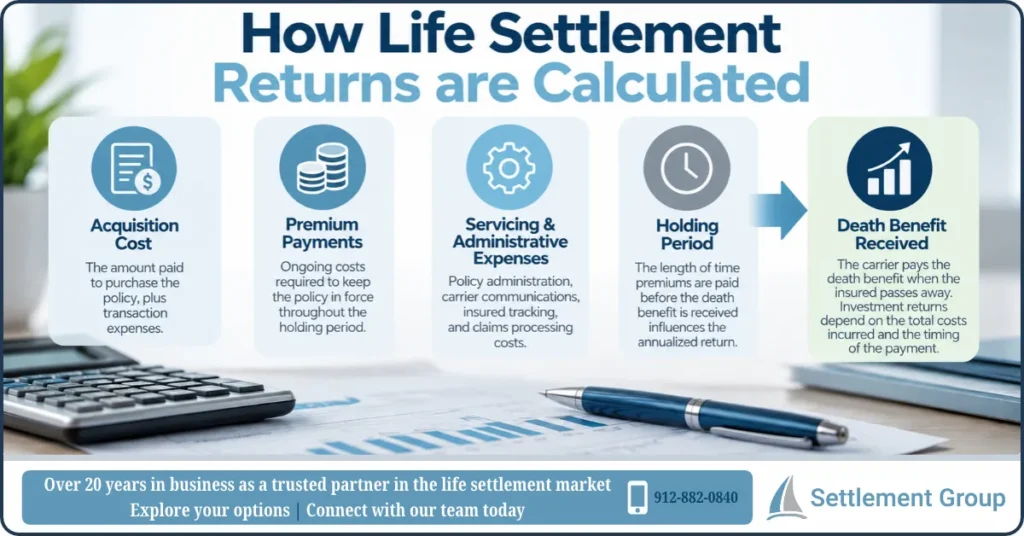
Understanding how life settlement returns are calculated is an important part of evaluating life insurance policies as alternative investments. Unlike traditional fixed-income investments, life settlements do not provide scheduled interest payments or predetermined maturity dates. Instead, investment performance depends on the amount paid to acquire a policy, the premiums and expenses incurred while maintaining it, and the timing and amount of the death benefit ultimately received.
For institutional purchasers and funding partners, calculating potential returns requires more than comparing the purchase price to the policy’s face value. Life expectancy estimates, premium obligations, holding periods, and portfolio expenses all influence projected and realized investment performance.
What Determines the Return on a Life Settlement Investment?
A life settlement investment begins when a purchaser acquires an existing life insurance policy from its owner. The purchaser assumes responsibility for maintaining the policy and receives the death benefit when the insured passes away.
Several factors determine the investment’s financial outcome:
- Acquisition price: The amount paid to purchase the policy, together with applicable transaction expenses.
- Death benefit: The amount payable under the policy, subject to its terms and any applicable adjustments.
- Premium payments: The ongoing costs required to maintain the policy throughout the holding period.
- Life expectancy: An actuarial estimate used to project how long the policy may need to be maintained before a claim occurs.
- Servicing and administrative expenses: Costs associated with policy administration, carrier communications, insured tracking, and claims processing.
- Holding period: The actual length of time between acquisition and receipt of the death benefit.
A policy purchased at an attractive price may produce a lower-than-expected return if premium payments continue substantially longer than projected. Conversely, a shorter holding period may reduce cumulative premium expenses and increase the investment’s annualized return.
How Is the Profit on a Life Settlement Calculated?
At its simplest, the net profit from a life settlement can be calculated by subtracting the total acquisition, premium, and other investment expenses from the death benefit received.
Net Profit = Death Benefit Received − Acquisition Cost − Premiums Paid − Other Investment Expenses
Consider a hypothetical simplified life settlement investment with the following characteristics:
| Investment component | Amount |
| Policy death benefit | $1,000,000 |
| Acquisition cost | $300,000 |
| Annual premium payments | $30,000 |
| Holding period | 5 years |
| Total premiums paid | $150,000 |
| Other investment expenses | $10,000 |
| Total invested capital | $460,000 |
| Net profit | $540,000 |
In this example, the purchaser receives a $1 million death benefit after investing a total of $460,000, resulting in a net profit of $540,000.
How Is Internal Rate of Return (IRR) Calculated for Life Settlements?
Internal rate of return, commonly referred to as IRR, is one of the primary measures used to evaluate life settlement investments. IRR accounts for both the amount and timing of cash flows, making it more informative than a simple comparison of total investment costs and death benefit proceeds.
A life settlement’s cash flows typically include an initial acquisition outflow, subsequent premium and servicing expenses, and a final inflow when the death benefit is received. IRR is the discount rate at which the present value of those cash flows equals zero.
Using the hypothetical policy above, the purchaser initially invests $300,000, pays $30,000 in premiums annually for five years, incurs $10,000 in additional expenses, and receives $1 million at the end of the fifth year. Assuming the additional expenses are paid at acquisition and premiums are paid at each year-end, the investment produces an annual IRR of approximately 18%.
This is an illustrative calculation, not a typical or expected life settlement return. Actual results depend on the specific policy, timing of cash flows, and expenses included in the calculation.
How Does Life Expectancy Affect Life Settlement Returns?
Life expectancy is one of the most important variables in life settlement valuation because it helps estimate the anticipated holding period. Medical underwriting companies evaluate available health information, medical history, and other relevant factors to develop actuarial estimates of an insured’s remaining life expectancy.
These estimates are projections rather than fixed maturity dates. An insured may live for a shorter or longer period than projected, directly affecting the timing of death benefit proceeds and the amount of premiums required to maintain the policy.
If an insured lives longer than anticipated, the purchaser must continue funding premiums and servicing expenses. The additional costs and delayed receipt of the death benefit can reduce the investment’s annualized return. If the policy matures sooner than projected, fewer premium payments may be required, potentially increasing the annualized return.
Institutional purchasers therefore evaluate multiple longevity scenarios rather than relying exclusively on a single projected maturity date.
How Do Premium Payments Affect Investment Performance?
Premium payments represent an ongoing capital obligation that must be incorporated into life settlement return calculations. Unlike the acquisition price, which is generally established at closing, future premium requirements may extend over an uncertain period.
Some policies have relatively predictable premium schedules, while others may require adjustments based on policy performance, cost-of-insurance charges, or other contractual provisions. Purchasers must evaluate these requirements during acquisition and continue monitoring them throughout the holding period.
Premium assumptions also influence the purchase price an investor may be willing to pay. Two policies with identical death benefits and similar life expectancy estimates may have substantially different valuations if their projected premium obligations differ.
Accurate premium modeling is therefore essential to estimating potential returns, determining capital requirements, and managing liquidity.
What Is the Difference Between Projected and Realized Life Settlement Returns?
Projected returns are calculated before an investment matures using assumptions about acquisition costs, future premiums, expenses, and the anticipated timing of death benefit proceeds. These projections help purchasers compare potential acquisitions and evaluate whether a policy meets their investment criteria.
Realized returns are calculated using the actual cash flows that occur throughout the investment. Once the death benefit has been collected, the purchaser can determine the investment’s financial outcome based on the actual holding period, premiums paid, and expenses incurred.
The difference between projected and realized returns can be significant because the timing of death benefit payments cannot be known in advance. This uncertainty is a defining characteristic of life settlement investments and an important consideration in underwriting, pricing, and portfolio construction.
How Are Returns Evaluated Across a Life Settlement Portfolio?
Institutional investors frequently acquire multiple policies rather than relying on the performance of a single life settlement. Portfolio-level return calculations consider the combined acquisition costs, premium obligations, administrative expenses, and death benefit proceeds associated with the underlying policies.
Each policy has its own expected holding period, premium schedule, death benefit, and underwriting characteristics. As policies mature at different times, their cash flows contribute to the overall portfolio’s performance.
Portfolio IRR is calculated using the timing and amount of the portfolio’s aggregate cash flows, rather than simply averaging the individual IRRs of its policies. Investors may also evaluate invested capital, realized proceeds, unrealized asset values, liquidity requirements, and performance under different longevity scenarios.
Diversification across policies, insured lives, and issuing carriers may help manage certain concentrations, but it does not eliminate longevity risk, liquidity risk, or the possibility of investment losses. The structure of the portfolio and the timing of its cash flows remain central to evaluating performance.
Why Is Ongoing Portfolio Servicing Important to Life Settlement Returns?
Return calculations do not end when a policy is purchased. Throughout the holding period, institutional purchasers must monitor premium payments, policy status, carrier communications, and changes that may affect projected expenses or cash flows.
Ongoing policy servicing provides information used to update financial projections, assess liquidity requirements, and maintain policies in force. Accurate records of premium payments and other expenses are also necessary for calculating realized investment performance.
For portfolios containing multiple policies, consistent administration supports financial reporting and helps purchasers evaluate individual assets alongside the performance of the overall portfolio.
How Does Settlement Group Support Institutional Life Settlement Transactions?
Understanding how life settlement returns are calculated requires consideration of both the initial acquisition and the ongoing financial obligations associated with maintaining purchased policies. Acquisition costs, premium schedules, longevity assumptions, servicing expenses, and the timing of death benefit proceeds all contribute to the investment’s ultimate performance.
Settlement Group works with institutional purchasers and funding partners in the secondary market for life insurance. This includes policy acquisitions, portfolio servicing and maintenance, and participation in capital markets and tertiary transactions.
Institutional purchasers and funding partners can contact Settlement Group at 912-882-0840 to discuss life settlement transactions and portfolio support.