When a client no longer needs or wants an existing life insurance policy, surrendering it to the insurance carrier may seem like the most straightforward option. However, advising clients on life settlement vs. cash surrender value requires understanding that a policy may have value beyond the amount available through surrender. Selling a qualifying policy through a life settlement can provide the owner with a payment far greater than the carrier’s cash surrender value.
For financial advisors and insurance agents, evaluating these alternatives can be an important part of helping clients make informed decisions about existing coverage. Understanding how each option works, what determines its value, and which policies may qualify for a settlement can help identify opportunities that might otherwise be overlooked.
What Is Cash Surrender Value?
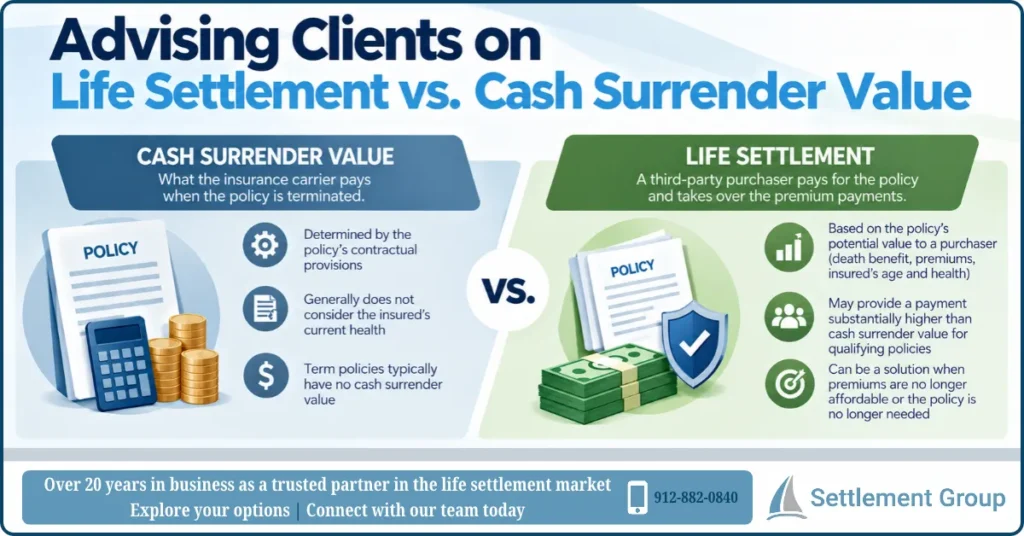
Cash surrender value is the amount a policy owner may receive from an insurance carrier when voluntarily terminating a life insurance policy. For permanent policies that accumulate cash value, the amount available upon surrender depends on the policy’s contractual provisions, accumulated values, applicable surrender charges, outstanding loans, and other adjustments.
Although cash surrender value can provide access to funds, it does not necessarily reflect what a third-party purchaser might be willing to pay for the policy. The carrier’s surrender calculation and a life settlement valuation serve different purposes and consider different factors.
Term life insurance policies generally do not accumulate cash value, meaning there may be no payment available if the owner allows coverage to expire or terminates the policy. However, certain term policies may still have potential market value, particularly when they include an available conversion option.
How Is a Life Settlement Different from Cash Surrender Value?
A life settlement involves the sale of an existing life insurance policy to a third-party purchaser. In exchange for an agreed payment, the policy owner transfers ownership and beneficiary rights, and the purchaser assumes responsibility for maintaining the policy and becomes entitled to the death benefit.
Unlike cash surrender value, which is determined under the insurance contract, a life settlement offer reflects an evaluation of the policy’s potential value to a purchaser. Factors considered include the death benefit, policy type, future premium obligations, the insured’s age and health, life expectancy estimates, and the financial strength of the issuing carrier.
Because these considerations differ from those used to determine cash surrender value, a qualifying policy may attract a settlement offer that far exceeds the amount available through surrender. However, not every policy qualifies.
Life Settlement vs. Cash Surrender Value: Key Differences
| Consideration | Cash Surrender Value | Life Settlement |
| Transaction | Policy is surrendered to the carrier | Policy is sold to a third-party purchaser |
| Payment determination | Based on contractual policy provisions | Based on purchaser valuation |
| Insured’s health | Generally does not directly determine surrender value | Significantly affects eligibility and valuation |
| Death benefit | Coverage terminates upon surrender | Rights transfer to the purchaser |
| Future premiums | No further premiums after surrender | Purchaser assumes responsibility for maintaining coverage |
| Term policies | Generally have no cash surrender value | Certain policies may qualify, including convertible term coverage |
| Process | Handled through the issuing carrier | Involves underwriting, documentation, and applicable settlement requirements |
Both options involve relinquishing the existing coverage, except in some life settlement scenarios where a policy qualifies for a retained death benefit settlement. Advisors should therefore consider the client’s ongoing insurance needs, financial objectives, potential tax consequences, and available alternatives before recommending either transaction.
Which Clients May Benefit from a Life Settlement Evaluation?
Life settlements are not appropriate for every policy owner, but certain circumstances may warrant additional review before a policy is surrendered or allowed to lapse. Advisors may encounter these opportunities during retirement planning, estate planning, business succession discussions, or periodic insurance reviews.
Potential candidates include clients who are age 65 or older, individuals whose health has changed significantly since their policies were issued, or owners of larger policies that are no longer needed for their original purpose. Policies with increasing premium obligations also warrant review, particularly when the owner is considering surrender because maintaining coverage has become financially burdensome.
Term life insurance policies approaching expiration or the end of their conversion periods represent another potential opportunity. Although term policies generally have no cash surrender value, an available conversion privilege may make certain policies eligible for a settlement. Eligibility depends on the specific policy provisions, conversion requirements, insured characteristics, and purchaser criteria.
A change in health can influence a policy’s market value, but declining health is not an absolute requirement for every transaction. Certain healthy insured individuals may qualify, particularly in situations involving convertible term coverage or other favorable policy characteristics.
What Should Advisors Review Before Recommending Surrender?
Before recommending that a client surrender a life insurance policy, advisors should evaluate both the client’s insurance needs and the financial alternatives available. A surrender decision is difficult or impossible to reverse once coverage has terminated, making it important to identify potential opportunities before completing the transaction.
Several considerations can help guide the review:
- Current surrender value: Obtain an updated illustration or written surrender quote from the issuing carrier, including applicable charges and outstanding loan balances.
- Policy type and provisions: Review the coverage, death benefit, premium structure, and any conversion or continuation options.
- Insured’s age and health: Consider whether current circumstances may support a life settlement evaluation.
- Ongoing coverage needs: Determine whether the client still requires some or all of the existing death benefit.
- Available alternatives: Compare surrender and settlement options with other potential solutions, such as policy loans, reduced paid-up coverage, accelerated death benefits, or policy adjustments when available.
- Tax and financial considerations: Encourage the client to review potential tax consequences and any effects on financial assistance or benefit eligibility with qualified professionals.
The goal is not to recommend a life settlement in every situation, but to ensure that the client understands the available options before making a final decision.
Can a Life Settlement Provide More Than Cash Surrender Value?
A qualifying life insurance policy is often worth much more to a third-party purchaser than the amount the insurance carrier would pay upon surrender.
However, a higher settlement payment is not guaranteed. Some policies may not qualify for an offer or may have no value beyond the cash value. Obtaining an evaluation can help advisors determine whether a meaningful difference exists before the client makes a decision.
How Can Financial Professionals Incorporate Life Settlements into Policy Reviews?
Life settlement evaluations can be incorporated into existing insurance review processes. When a client expresses an intention to surrender coverage, discontinue premium payments, or allow a policy to lapse, the advisor can consider whether a settlement evaluation may be beneficial before the policy is terminated.
This approach is particularly useful when reviewing older permanent policies, coverage associated with completed estate planning objectives, business-owned insurance that is no longer needed, or term policies approaching conversion deadlines.
For financial professionals, identifying potential settlement opportunities can provide clients with additional information while supporting more comprehensive insurance planning. The evaluation process allows advisors to compare a potential market offer against the carrier’s surrender value and other available options before helping the client determine the appropriate course of action.
Working With Settlement Group
The Settlement Group, Inc. has more than 20 years of experience in the life settlement industry and works with financial professionals to evaluate policies for potential settlement opportunities. As a licensed life settlement provider, Settlement Group facilitates policy acquisitions and works with institutional funding partners in the secondary market for life insurance.
Financial advisors and insurance agents can submit qualifying policy information for evaluation before their clients surrender coverage or allow policies to lapse. A settlement evaluation can help determine whether a policy may attract an offer greater than its cash surrender value, providing additional information for the client’s decision-making process.
Before your client surrenders a life insurance policy, consider whether a life settlement may provide them with more value. Contact Settlement Group at 912-882-0840 or use our Get a Quote form to submit a policy for review.