The history of the life settlement market dates back more than a century, beginning with a landmark U.S. Supreme Court decision that established the right to transfer ownership of an existing life insurance policy. What began as a legal recognition of life insurance as personal property eventually developed into a secondary market involving licensed providers, institutional purchasers, funding partners, and specialized servicing organizations.
Over time, changes in medical treatment, insurance regulation, underwriting practices, and institutional participation have shaped how life settlements are acquired, valued, and managed. Understanding this evolution provides useful context for the structure of today’s market and the role life settlements play as an alternative asset class.
Where Did the Life Settlement Market Begin?
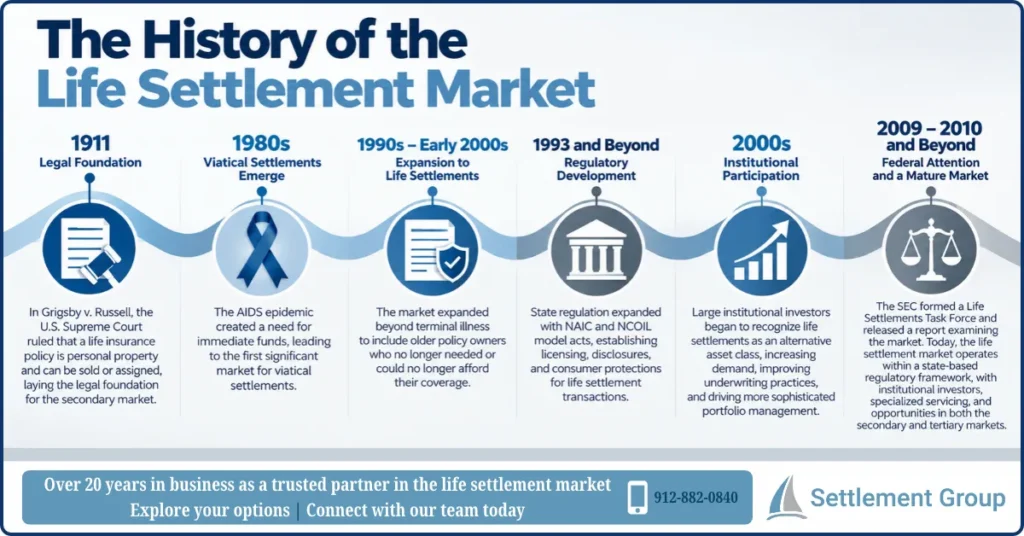
The legal foundation of the life settlement market is commonly traced to the 1911 U.S. Supreme Court decision Grigsby v. Russell. The case involved the transfer of a life insurance policy from its original owner to a third party who agreed to assume future premium obligations. After the insured’s death, the validity of the transfer was challenged because the purchaser did not have an insurable interest in the insured’s life.
Writing for the Court, Justice Oliver Wendell Holmes Jr. recognized that a validly issued life insurance policy could be transferred as property. The decision distinguished the legitimate assignment of an existing policy from arrangements involving insurance obtained as a wager on another person’s life. This distinction helped establish the legal framework that would eventually support the secondary market for life insurance.
Although the decision did not create an organized life settlement industry, it established an important principle: an existing life insurance policy may have transferable economic value beyond the benefits available directly from the issuing carrier, subject to applicable law.
How Did the Viatical Settlement Market Develop?
The modern secondary market began taking shape during the 1980s, particularly in response to the AIDS epidemic. Individuals facing serious illnesses often needed financial resources for medical treatment and living expenses, while their existing life insurance policies represented assets that could potentially be sold.
Viatical settlements provided a way for qualifying policy owners to receive a payment in exchange for transferring ownership and beneficiary rights to a purchaser. The buyer assumed responsibility for maintaining the policy and became entitled to the death benefit. These early transactions helped establish many of the acquisition and administration practices that later became part of the broader life settlement industry.
The introduction of more effective HIV treatments during the 1990s also demonstrated the importance of longevity assumptions in valuing life insurance policies. As medical advances extended life expectancies, some purchasers experienced substantially longer holding periods and additional premium obligations. These developments reinforced the need for careful medical underwriting, realistic financial projections, and ongoing policy management.
When Did Life Settlements Become a Broader Market?
During the 1990s and early 2000s, the secondary market expanded beyond policies associated with terminal illness. Purchasers increasingly evaluated policies owned by older individuals who no longer needed their coverage, could no longer justify the premiums, or preferred to access the policy’s value during their lifetime.
These transactions became widely known as life settlements. Unlike many early viatical transactions, life settlements often involved insured individuals with longer projected life expectancies, creating different requirements for pricing, capital planning, and policy administration.
This expansion also changed how purchasers evaluated potential acquisitions. Medical underwriting, policy illustrations, future premium obligations, carrier financial strength, and projected holding periods became central considerations. As transaction volume and policy diversity increased, the market developed more specialized functions involving underwriting, acquisition, servicing, and portfolio management.
How Did Regulation Shape the Life Settlement Industry?
As the secondary market developed, state regulators and industry organizations worked to establish standards for transactions and protect policy owners. In 1993, the National Association of Insurance Commissioners (NAIC) adopted its Viatical Settlements Model Act, providing a framework that states could use when developing their own regulatory requirements.
The National Conference of Insurance Legislators (NCOIL) subsequently developed its own model legislation addressing life settlement transactions. Over time, these frameworks were revised to reflect changes in the market, including the growth of senior life settlements and concerns involving stranger-originated life insurance, commonly referred to as STOLI.
STOLI arrangements generally involve policies initiated for the benefit of investors rather than for legitimate insurance purposes. Regulators sought to distinguish these arrangements from the lawful secondary-market transfer of existing policies, consistent with the principles underlying Grigsby v. Russell.
Today, life settlement regulation remains primarily state-based. Requirements vary by jurisdiction but may address provider and broker licensing, disclosures, transaction documentation, rescission rights, privacy protections, and restrictions on certain policy transfers. For institutional purchasers and funding partners, compliance with applicable requirements remains an important part of acquisition due diligence and transaction administration.
When Did Institutional Investors Enter the Life Settlement Market?
As the market expanded to include policies with longer projected holding periods, life settlements attracted interest from institutional capital sources. Investment funds, specialized asset managers, and other purchasers began evaluating life insurance policies as assets with contractual death benefits and cash flows that are not directly determined by traditional stock or bond market performance.
Institutional participation encouraged the development of more sophisticated underwriting, valuation, and portfolio management practices. Purchasers needed to evaluate not only individual policy characteristics but also the capital required to maintain multiple policies over uncertain holding periods. This increased the importance of premium modeling, liquidity planning, diversification, and specialized servicing.
The growth of institutional activity also attracted federal regulatory attention. In 2009, the Securities and Exchange Commission established a Life Settlements Task Force to examine the market and its regulatory framework. The task force’s 2010 report addressed investor protection concerns, the treatment of life settlements under securities laws, and differences in regulatory oversight.
Although the report did not establish a single federal regulatory framework for all life settlement transactions, it reflected the increasing complexity of the market and the importance of transparency, compliance, and investor due diligence.
How Did Life Settlement Portfolios and the Tertiary Market Develop?
As institutional participation expanded, purchasers increasingly evaluated life settlements as portfolios rather than solely as individual policy acquisitions. Portfolio structures allowed investors to acquire and manage multiple policies with different death benefits, issuing carriers, premium obligations, and projected holding periods.
This development increased the importance of ongoing policy servicing and portfolio-level financial management. Institutional participants needed systems for monitoring premium payments, maintaining carrier records, tracking insured status, updating financial projections, and coordinating death benefit claims. These responsibilities became essential to maintaining acquired policies and managing the capital committed to them.
The market also developed opportunities for previously acquired policies to be transferred between purchasers. These transactions, commonly described as the tertiary market, may involve individual policies or portfolios sold between institutional participants. Tertiary transactions provide additional ways to acquire existing life settlement assets, adjust portfolio composition, or transfer policy ownership as investment objectives change.
What Does the Life Settlement Market Look Like Today?
Today’s life settlement market includes a range of participants involved in policy origination, acquisition, underwriting, funding, administration, and portfolio transactions. Licensed providers facilitate policy purchases, while institutional funding partners and other purchasers supply capital for acquisitions and ongoing premium obligations.
Medical underwriting and actuarial analysis remain important to valuation, while policy servicing supports the administration of acquired assets throughout their holding periods. Institutional purchasers also evaluate regulatory compliance, carrier exposure, premium requirements, and liquidity when considering individual policies or larger portfolios.
The market continues to operate within a state-based regulatory environment, with transaction requirements determined by applicable laws and the circumstances of each acquisition. For investors, the development of specialized acquisition and servicing functions reflects the increasingly sophisticated nature of the secondary market for life insurance.
How Has Settlement Group Participated in the Evolution of the Market?
The Settlement Group, Inc. has operated in the life settlement industry for more than 20 years, participating in a market that has evolved through regulatory changes, increased institutional involvement, and the development of more sophisticated acquisition and servicing practices.
As a licensed life settlement provider, Settlement Group works with institutional purchasers and funding partners in the secondary market. Its activities extend beyond individual policy acquisitions to include portfolio servicing and maintenance, as well as participation in capital markets and tertiary transactions.
This combination of acquisition experience and ongoing portfolio support reflects the broader development of the life settlement industry, where maintaining and managing purchased policies is an important part of institutional participation.
Why Is the History of the Life Settlement Market Important to Investors?
The history of the life settlement market helps explain the legal, regulatory, and financial considerations that shape institutional transactions today. The recognition of life insurance as transferable property established the foundation for the secondary market, while the viatical era demonstrated the importance of life expectancy underwriting and ongoing premium obligations.
Subsequent regulatory developments introduced additional transaction requirements, and institutional participation contributed to the growth of specialized underwriting, acquisition, servicing, and portfolio management practices. Together, these developments have shaped a market in which careful due diligence and ongoing administration remain important throughout the investment lifecycle.
Institutional purchasers and funding partners can contact Settlement Group at 912-882-0840 to discuss life settlement transactions and portfolio support.