Purchasing a life insurance policy on the secondary market involves more than funding the initial acquisition. Understanding capital requirements in life settlement transactions means accounting for both the purchase price and the ongoing capital needed to maintain the policy throughout the holding period.
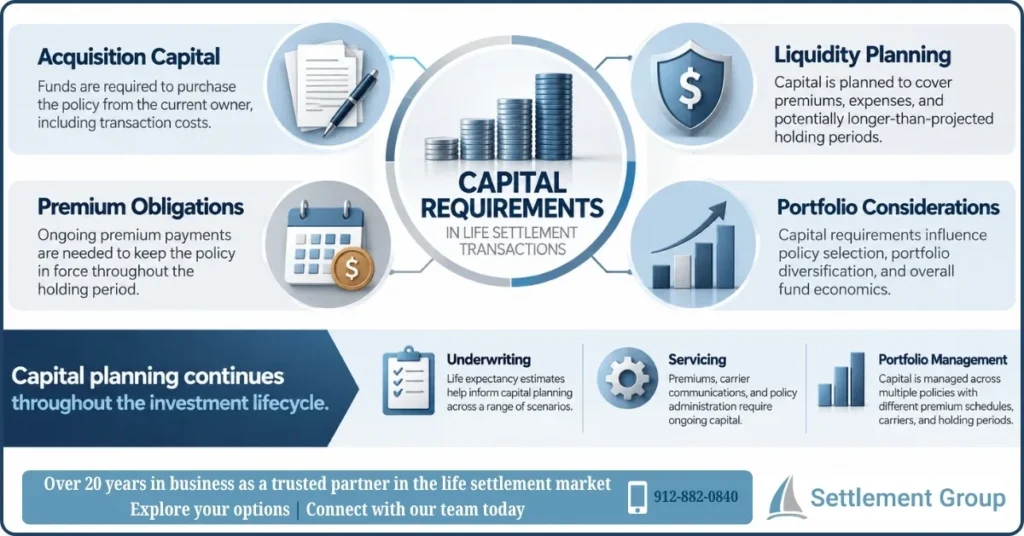
For institutional investors, those requirements influence policy valuation, liquidity planning, portfolio construction, and expected returns. Because the timing of a policy’s maturity cannot be known in advance, capital planning must account for a range of potential outcomes rather than a single projected date.
What Capital Is Required to Purchase a Life Settlement?
The amount paid to acquire a policy is only one component of the capital required for a life settlement investment.
After acquisition, the new owner assumes responsibility for maintaining the policy, including the premiums necessary to keep it in force. Depending on the policy, those obligations may continue for years.
Investors therefore evaluate several potential uses of capital when considering an acquisition, including:
- Policy acquisition cost
- Expected future premiums
- Potential changes in premium requirements
- Servicing and administrative expenses
- Liquidity needed if the holding period extends beyond initial projections
The resulting capital requirement is not necessarily a single fixed amount determined at closing. It changes with the duration of the investment and the ongoing economics of the policy.
How Do Life Expectancy Estimates Affect Capital Requirements?
Life expectancy underwriting is an important part of capital planning because it helps investors model the potential duration of premium obligations.
A life expectancy estimate provides an actuarial projection rather than a maturity date. Actual longevity can differ from the estimate, which means investors must consider what happens financially if a policy remains in force longer than initially projected.
A longer holding period can result in additional premium payments and other expenses before the death benefit is received. Those additional cash requirements can materially affect the economics of the investment.
For that reason, investors may model multiple longevity scenarios rather than relying on a single life expectancy assumption. This allows them to evaluate how different holding periods could affect required capital and expected returns.
How Are Future Premium Obligations Evaluated?
Premium requirements can vary significantly from one policy to another.
During due diligence, investors may review current policy information, carrier illustrations, premium schedules, policy values, cost of insurance provisions when applicable, and other policy-specific factors that could affect future funding requirements.
The objective is not simply to determine the next premium due. Investors need to understand the amount of capital that may be required to maintain the policy over different potential holding periods.
This analysis becomes particularly important when evaluating portfolios containing numerous policies with different premium schedules and policy structures.
How Do Institutional Investors Plan for Liquidity?
Life settlement investing creates a timing difference between cash outflows and cash inflows. Acquisition costs and premiums require capital before the corresponding death benefits are ultimately received.
Institutional investors therefore have to consider liquidity alongside expected investment returns.
Depending on the investment structure, capital may be allocated or reserved for future premium obligations and other portfolio expenses. Investors may also model scenarios in which multiple policies require continued funding beyond their initial projections.
Maintaining adequate liquidity helps prevent the portfolio from becoming dependent on precise timing assumptions for individual policies.
How Does Capital Planning Affect Portfolio Construction?
Capital requirements can directly influence which policies an investor acquires and how a life settlement portfolio is constructed.
Two policies with similar face values may have very different capital requirements because of differences in acquisition price, premium obligations, policy structure, and expected holding period.
At the portfolio level, investors may evaluate how individual acquisitions affect:
- Total projected premium obligations
- Liquidity requirements
- Expected cash flows
- Policy and carrier concentrations
- Life expectancy distribution
- Overall portfolio economics
A portfolio containing attractive individual policies can still create liquidity challenges if too much capital is required during overlapping periods.
Capital planning and portfolio construction therefore need to be considered together rather than as separate parts of the investment process.
How Does Carrier Financial Strength Factor into Capital Allocation?
The financial strength of the issuing insurance carrier is another consideration when evaluating a policy.
Institutional investors may review financial strength ratings from agencies such as AM Best and other available information when establishing acquisition criteria. Individual investors or funds may have their own requirements regarding acceptable carriers and ratings.
Carrier exposure can also be evaluated at the portfolio level. Even when individual carriers satisfy an investor’s acquisition standards, excessive concentration with one insurer may create additional portfolio risk.
As a result, decisions about deploying capital may consider both the characteristics of an individual policy and its effect on the portfolio’s overall carrier exposure.
What Due Diligence Is Performed Before Capital Is Deployed?
Capital is generally deployed only after the policy and transaction have undergone due diligence.
Depending on the transaction and jurisdiction, this can include reviewing policy ownership, policy documentation, carrier information, underwriting materials, required disclosures, licensing, transaction documents, and other compliance requirements.
Institutional purchasers may also establish their own requirements for the providers, brokers, servicing companies, and other parties involved in a transaction.
This review is important because the value of a life settlement asset depends on more than its projected financial performance. Proper acquisition, documentation, compliance, and ongoing administration are also important to the integrity of the transaction.
Why Does Ongoing Portfolio Servicing Matter to Capital Planning?
Capital planning continues after a policy is acquired.
Premium obligations must be monitored throughout the holding period, along with carrier communications, policy status, insured tracking, and other administrative requirements. Changes affecting a policy’s future funding needs may also require updated projections or adjustments to portfolio-level liquidity planning.
For institutional investors, effective servicing therefore has a direct relationship to capital management. Maintaining accurate policy information and premium schedules helps investors understand both current obligations and potential future cash requirements across the portfolio.
Understanding Capital Requirements in Life Settlement Transactions
Understanding capital requirements in life settlement transactions requires looking beyond the initial acquisition price. Future premiums, longevity assumptions, liquidity, policy structure, carrier exposure, servicing, and portfolio composition can all influence the amount and timing of capital required throughout the investment lifecycle.
Settlement Group works with institutional purchasers and funding partners across the life settlement market, with experience spanning policy acquisition, transaction management, portfolio servicing and maintenance, and capital markets and tertiary transactions.
Institutional purchasers and funding partners can contact Settlement Group at 912-882-0840 to discuss life settlement transactions and portfolio support.