When investors gain exposure to the life settlement asset class, that exposure often involves a portfolio of policies rather than a single policy. Understanding how life settlement portfolios are structured is therefore important when evaluating the economics, risks, and management requirements of the asset class. By holding multiple policies, a portfolio can distribute longevity, carrier, premium, and policy-specific risks across a broader group of assets.
What Is a Life Settlement Portfolio?
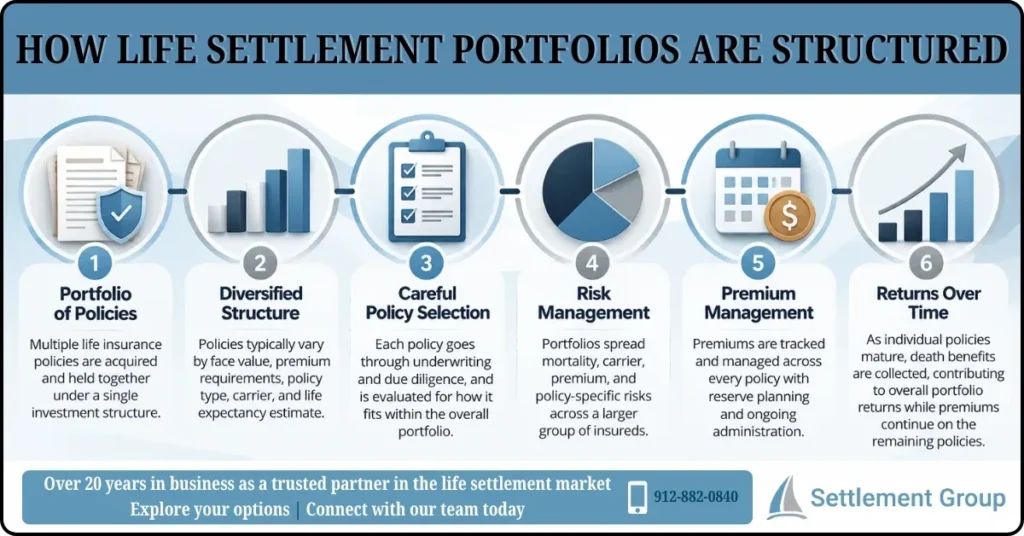
A life settlement portfolio is a collection of life insurance policies that have been acquired in the secondary market and assembled within an investment or ownership structure. Rather than invest in and rely on the performance of a single policy, a portfolio may contain dozens or hundreds of policies with different face values, premium requirements, policy structures, carriers, and life expectancy estimates.
The entity holding the policies is responsible for maintaining them according to their terms, including making required premium payments. As policies mature, death benefits are collected by the applicable beneficiary and become part of the portfolio’s overall cash flows.
Portfolio size and structure can vary considerably depending on the investor, fund strategy, acquisition criteria, available capital, and investment objectives.
How Can Investors Gain Exposure to Life Settlement Portfolios?
Life settlement investments can be structured in different ways depending on the investor and investment vehicle.
An investor or institution may acquire whole policies directly, assuming responsibility for the acquisition cost and ongoing premium obligations associated with those policies. Institutional investors may also participate through funds or other investment vehicles that hold portfolios of life insurance policies.
In a pooled structure, investor capital can be deployed across multiple policies rather than being concentrated in a single asset. This allows the investment vehicle to construct a broader portfolio while allocating capital according to its acquisition strategy and portfolio objectives.
The specific ownership, participation, and distribution structure depends on the investment vehicle and should not be assumed to be the same across all life settlement funds.
How Are Policies Selected for a Portfolio?
Policies entering a portfolio are generally evaluated individually before acquisition, but portfolio construction adds another level of analysis.
In addition to evaluating the economics of a particular policy, an institutional purchaser may consider how that policy affects the characteristics of the overall portfolio. Factors can include:
- Life expectancy estimates
- Face value
- Premium requirements
- Policy type and structure
- Insurance carrier
- Carrier financial strength
- Age and health characteristics of the insured
- Expected cash flows
- Existing concentrations within the portfolio
Acquisition criteria vary among investors and funds. The objective is not simply to acquire policies that appear attractive individually, but to understand how each acquisition affects the economics and risk profile of the portfolio as a whole.
How Does Diversification Work Within a Life Settlement Portfolio?
Diversification within a life settlement portfolio differs from diversification within a traditional securities portfolio.
One of the principal risks is longevity risk: the possibility that insureds live longer than projected, requiring the portfolio to continue paying premiums for a longer period before death benefits are received. A portfolio containing multiple insureds can reduce dependence on the outcome of any one policy.
Diversification can also extend beyond life expectancy. Portfolio managers may evaluate concentration by insurance carrier, policy size, policy type, insured characteristics, premium requirements, and other factors.
A larger and more diversified pool does not eliminate longevity risk or guarantee that actual experience will match projections. It can, however, reduce the effect that an unexpected outcome on a single policy has on the portfolio as a whole.
How Are Premiums Managed Across a Portfolio?
Ongoing premium management is a significant part of life settlement portfolio administration.
Each policy must be monitored for premium requirements, payment schedules, grace periods, policy values, and other factors that could affect its continued performance. Because premium obligations may continue longer than initially projected, portfolio managers must also account for the possibility of additional premium requirements when evaluating expected returns and liquidity needs.
Depending on the portfolio structure, capital may be reserved for future premiums or managed through other funding arrangements designed to maintain the policies throughout the expected holding period.
Policy servicing therefore continues well beyond the initial acquisition. It can include premium administration, carrier communications, policy monitoring, insured tracking, and maintenance of the documentation necessary to keep the portfolio properly administered.
How Do Life Settlement Portfolios Generate Returns?
The economics of a life settlement portfolio depend on the relationship between acquisition costs, ongoing premium obligations, the timing and amount of death benefits received, and other portfolio expenses.
As individual policies mature, the applicable death benefits are collected. At the same time, premium obligations continue for policies that remain in force.
The timing of these cash flows matters. If policies remain in force longer than projected, additional premiums can reduce expected returns. If maturities occur earlier than projected, fewer premium payments may be required. For this reason, life expectancy underwriting and premium modeling are important components of portfolio valuation and management.
Rather than depending on the outcome of a single policy, a portfolio’s overall performance reflects the combined experience of the policies it holds.
How Are Life Settlement Portfolios Managed Over Time?
Portfolio management does not end when policies are acquired.
Policies require ongoing administration throughout the holding period, including premium management, carrier communications, policy monitoring, insured tracking, and review of policy performance. Portfolio managers may also evaluate existing holdings as part of broader portfolio maintenance and capital planning.
Life settlement assets may also be involved in subsequent portfolio sales or other tertiary and capital markets transactions. As a result, the structure and management of a life settlement portfolio can extend from initial policy acquisition through servicing and later portfolio-level activity.
Understanding How Life Settlement Portfolios Are Structured
Understanding how life settlement portfolios are structured requires looking beyond the individual policies they contain. Acquisition criteria, diversification, premium obligations, life expectancy underwriting, servicing, liquidity, and portfolio management all influence how the assets perform collectively.
Settlement Group works across multiple stages of the life settlement market, including policy acquisition, portfolio servicing and maintenance, and capital markets and tertiary transactions.
To learn more about life settlement portfolios and life settlements as investments, call 912-882-0840 to speak with our team.